Environmental Sciences and Sustainability Major
September 25, 2014 2025-02-16 15:58Environmental Sciences and Sustainability Major
Lead in Sustainability
Environmental Sciences and Sustainability Major
Focus on preserving and protecting natural resources.
Interdisciplinary approach
Expertise
Small Class Sizes
Bachelor of Science in Environmental Sciences and Sustainability
Looking for a career that empowers you to make a positive impact on the planet? The environmental sciences and sustainability major at Lynchburg offers you a comprehensive, interdisciplinary approach to addressing pressing environmental challenges. Rooted in environmental science, sustainability, and conservation principles, the curriculum covers biology, ecology, hydrology, geology, and meteorology. Through hands-on laboratory work and field studies, you’ll develop scientific inquiry skills and gain insights into complex ecological systems.
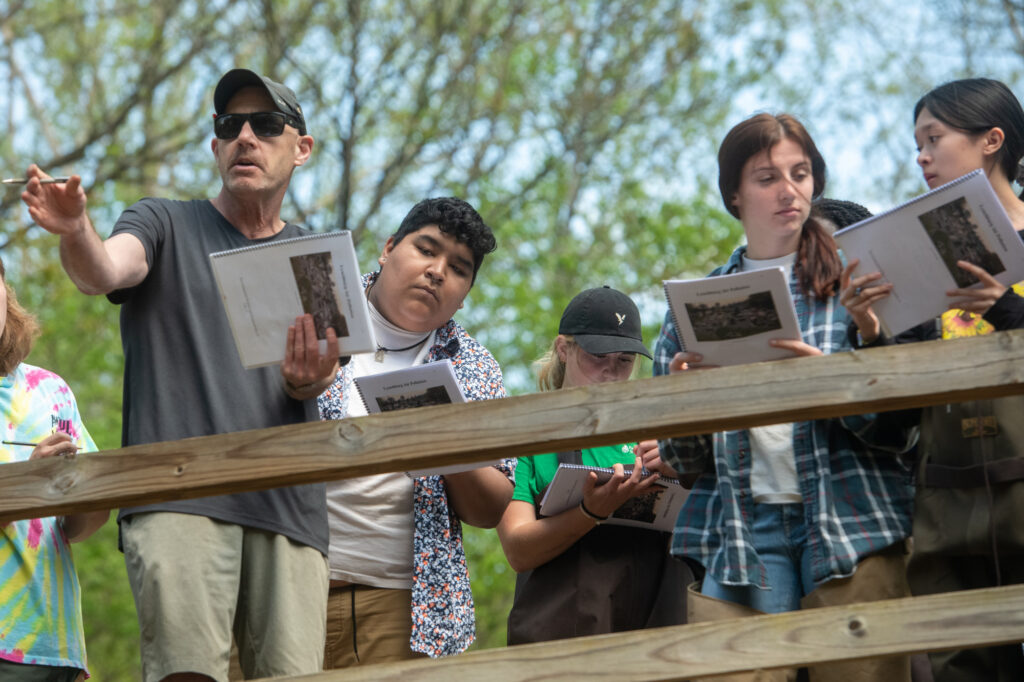
Program highlights include high-impact experiential learning opportunities with faculty offering a variety of engaging research projects and study-away experiences. For instance, students can study local environmental issues in Central Virginia, dig up dinosaurs in Wyoming, or investigate water quality in Costa Rica. Courses include geospatial training in remote sensing and GIS, explorations of the historical development of the Earth and its lifeforms, investigations into weather and climate change, and studies on various ecosystems such as wetlands, forests, streams and creeks, and urban areas. Sustainability concepts integrated into the curriculum prepare students to meet the social and economic challenges related to environmental science.
With this program, you’ll graduate prepared to tackle environmental challenges with creativity and critical thinking and equipped to make meaningful contributions to sustainability and environmental stewardship.
As a Lynchburg environmental sciences and sustainability major, you’ll:
- Acquire knowledge in the interdisciplinary nature of environmental sciences and sustainability, fostering collaboration and innovation in addressing global environmental issues.
- Learn the principles of biology, ecology, hydrology, geology, and meteorology to comprehend the complexities of the environment.
- Explore the historical development of Earth and life, emphasizing geological and biological processes that have shaped our planet.
- Learn techniques for conducting applied research, evaluating environmental policies, and implementing sustainable solutions.
Curriculum and Resources
2024-25 Academic Year Information
Program requirements for the following can be found in the undergraduate catalog.
- Actuarial Science (BS)
What Jobs Can I Get With an Environmental Science Degree?
The job market for environmental sciences and sustainability majors is expanding rapidly as businesses, governments, and organizations seek practical solutions to environmental challenges. According to the Bureau of Labor Statistics, employment in the environmental science sector is projected to grow by 8% from 2020 to 2030, faster than the average for all occupations.
These roles span across sectors such as government agencies, consulting firms, non-profit organizations, and private industry, offering diverse career opportunities for environmental sciences and sustainability graduates. Additionally, the growing focus on sustainability and environmental stewardship ensures a continued demand for professionals with expertise in this field.
Potential Jobs and Salaries:
- Environmental scientist: $73,230
- Sustainability consultant: $75,722
- Conservation scientist: $62,660
- Urban planner: $75,950
- Environmental educator: $61,660
- Renewable energy specialist: $74,973
- Climate change analyst: $77,580
- Environmental policy analyst: $71,360
- Water quality scientist: $71,360
- Landscape architect: $79,320
Salary and job projections come from national averages in the Bureau of Labor Statistics and other sources, including Glassdoor, Indeed, and industry-specific posts and publications. The data is meant to provide an idea of career options and salary ranges, not as a guarantee of obtaining these positions after graduation. These represent national averages and may vary by source and time frame collected. Actual salaries vary by region. Some jobs may require additional training or graduate education.
What are some of our graduates doing?
- Outreach Coordinator, Cacapon Institute, High View, West Virginia
- Professional Naturalist Fellow at Eagle Bluff Environmental Learning Center, Lanesboro, Minnesota
- Meteorologist, Bahamas Weather Service
- Hydrological Technician, U.S. Geological Survey
- NEPA (National Environmental Policy Act) Staff Professional at HDR, Inc., Vienna, Virginia
- Conservation Specialist, James River Soil and Water Conservation District, Prince George, Virginia