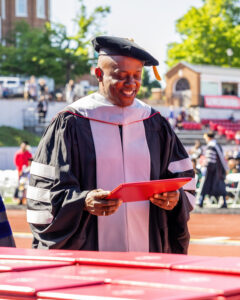
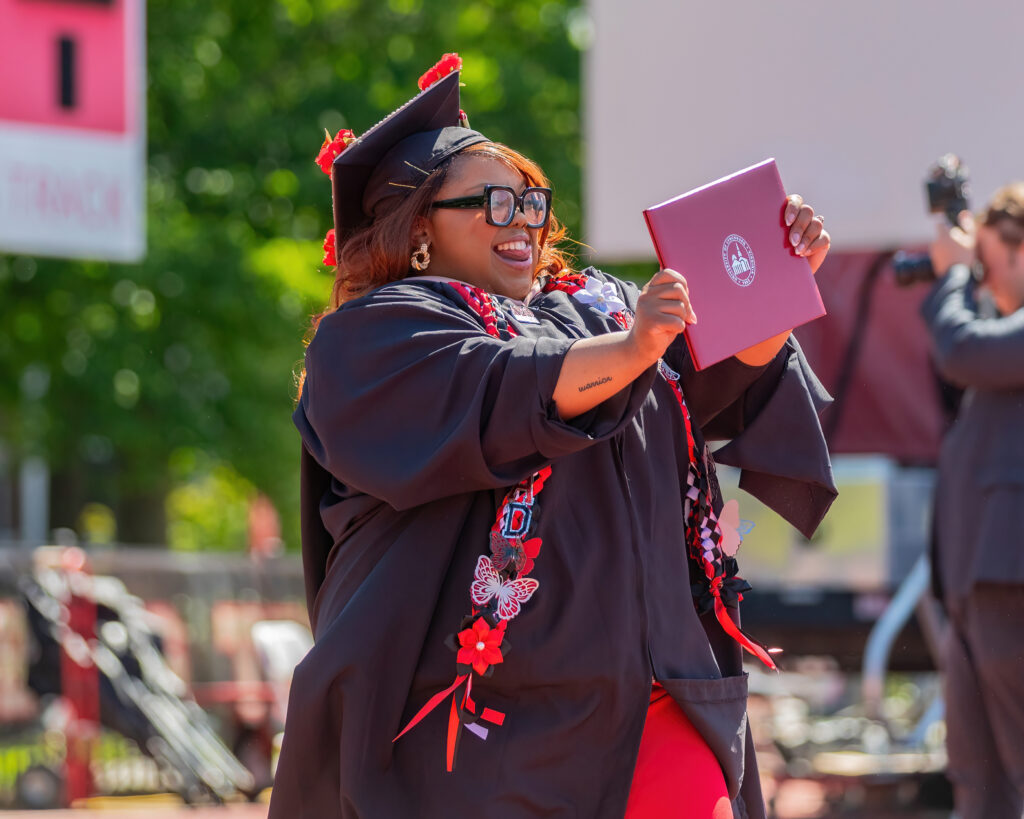
On Friday, May 8, 548 graduate degrees were conferred during the 2026 University of Lynchburg Graduate Commencement ceremony.
Of the degrees conferred, doctoral degrees included:
- 6 Doctor of Education in Leadership Studies
- 49 Doctor of Executive Leadership
- 288 Doctor of Medical Science
- 35 Doctor of Physical Therapy
Master’s degrees conferred included:
- 6 Master of Arts in Nonprofit Leadership Studies
- 19 Master of Business Administration
- 36 Master of Education
- 38 Master of PA Medicine
- 13 Master of Healthcare Administration
- 31 Master of Public Health
- 7 Master of Science in Athletic and Coaching Education
- 10 Master of Science in Athletic Training
- 6 Master of Science in Clinical Mental Health Counseling,
- 4 Master of Science in School Counseling
After an invocation given by Jer Bryant ’03, ’10 MA, associate University chaplain, the students were greeted by Julie Doyle, chair of the board of trustees, and Kathryn Whitestone-Goodman ’13, president of the alumni association.
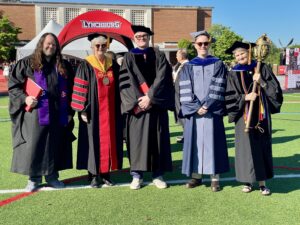
University President Dr. Alison Morrison-Shetlar took the podium next and greeted the graduates by acknowledging the hard work it took for them to get to this moment.
“You have earned, through years of extraordinary sacrifice and commitment, the right to be called experts in your field. … What you have done is incredible. Not just the degree. Not just the dissertation or the clinical hours or the capstone project. I mean all of it — the invisible labor that no transcript captures.”
With this ceremony marking her final Commencement at the University of Lynchburg, Morrison-Shetlar expressed camaraderie with the graduating students as they all prepared to step into their next chapters: “Like you, I am now asking myself: what comes next? It’s an exciting question.”
She reflected on lessons she has learned “as a person who has spent a lifetime in rooms where the stakes were high and the answers weren’t always clear.”
Her lessons spoke to the “courage to face change,” making sound decisions, and the importance of character built along the way.
“The professionals who transform their fields, who become the ones others turn to in moments of uncertainty, are not the ones who waited for the world to stabilize before they acted,” she said. “They are the ones who leaned into disruption, who asked better questions, who had the courage to say ‘I don’t know exactly where this is going, but I am going to lead the way forward anyway.’”
Morrison-Shetlar continued, “… perfect information is a myth. … The ability to act with clarity and confidence — even in the presence of uncertainty — is precisely what your patients, your clients, your teams, and your organizations are going to need from you.
“Trust your training. Trust your judgment. And trust yourself enough to act.”
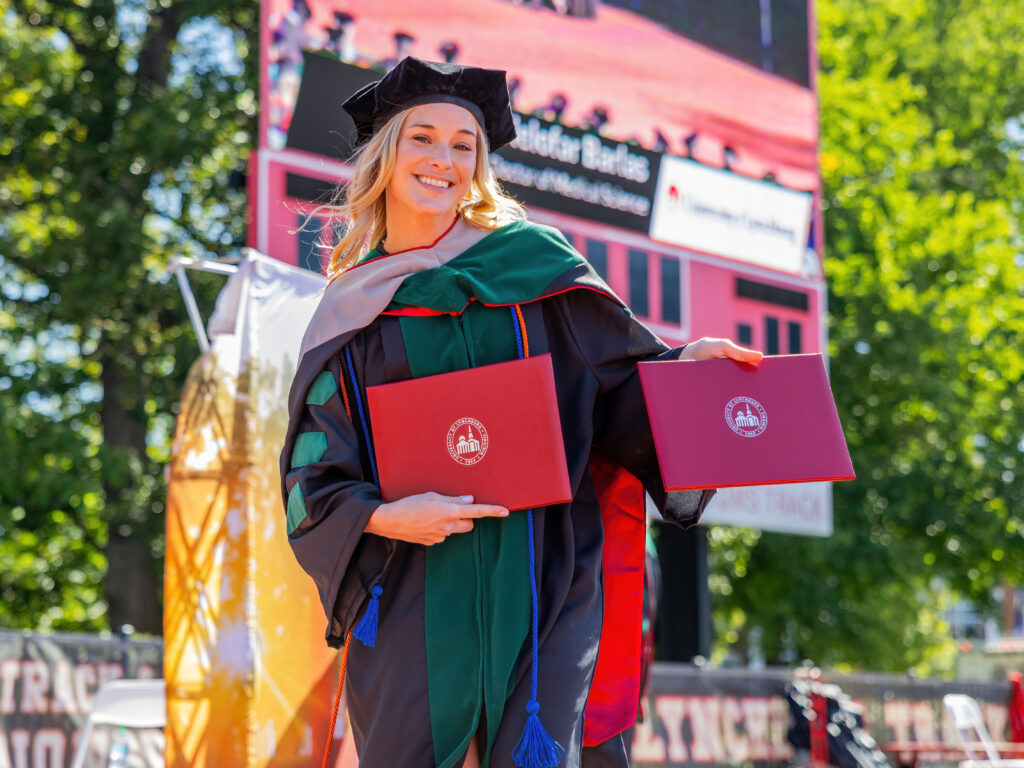
In her closing remarks, Morrison-Shetlar said, “You are walking out of here as professionals. As leaders. As the people that your patients, your clients, your students, your organizations, and your communities are going to turn to and count on. That is an extraordinary responsibility. And you are ready for it.”
Next, Dr. Chip Walton, interim chief academic officer and vice president of academics greeted the students and introduced the Commencement speaker, John Garrison Marks ’10.
Marks is a historian, writer, and nationally recognized leader in the history and museum fields. At Lynchburg, he was a double major in history and Spanish with a minor in museum studies. He was also a Westover Honors Fellow and cum laude graduate.
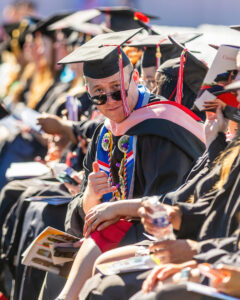
He has published in The Washington Post, Time magazine, Smithsonian magazine, and for the last few years he has worked for the American Association of State and Local History. His latest book, “Thy Will Be Done: George Washington’s Legacy of Slavery and the Fight for American Memory” explores how Americans have defined Washington’s legacy over the years.
In his address, Marks discussed the impact of advancing technology on our abilities to focus and think critically and connected them with stories from history.
He opened by explaining the immense pressures and conflicts President Abraham Lincoln faced during the Civil War.
“Before he even took office, Lincoln essentially became the president who lost half the country. … As if the Civil War wasn’t enough, Lincoln faced personal tragedy that year as well. In February 1862, as war raged, Abraham Lincoln’s 11-year-old son Willie died of typhoid.”
Marks explained that Lincoln, who struggled with “bouts of melancholy,” had to support his family through personal and national tragedy. He carried more than many of us could imagine carrying ourselves.
“For us here today though, it’s the way Lincoln managed these unbelievable demands on his time, intellect, and conscience — how he managed to find a way to block out the chaos and distraction — that holds the most important lesson,” Marks said.
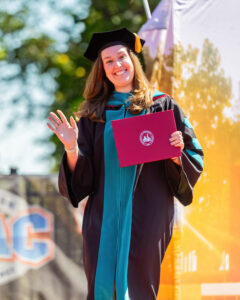
Marks continued that Lincoln took the time to “think deeply, to process, and to write” while staying at the “Soldier’s Home,” now called President Lincoln’s Cottage, outside of Washington, D.C.
“Few of us will ever be challenged like Lincoln was. But his story helps highlight something that has become increasingly clear in recent years: achieving anything, living up to our potential, even just maintaining our humanity demands we pull ourselves away from endless sources of distraction.”
At this point in his speech, Marks shifted to address the constant source of distraction we all face in our daily lives — smart phones.
“The smart phone era of the past two decades has been nothing short of disastrous for our minds,” Marks explained. “Americans’ attention spans today are only one-third of what they were 20 years ago.”
He continued, “Meanwhile, the number of Americans who report difficulty concentrating has steadily increased. Just having our phone in the room — even when we’re not looking at it — has been shown to negatively affect our ability to concentrate.”
Marks stressed the importance of breaking our “addiction” to our phones, social media, and other digital distractions.
“Being bored is good for you. … You should allow yourself the privilege of being bored. You should welcome it, even demand it. That’s when your mind can do its best work.”
As he closed, Marks spoke to the importance of reading. “Reading is the best thing you could possibly do for both your career, and for yourself,” he said.
“Bit by bit, reading rewires and strengthens our brains. It keeps us mentally fit. This training for our minds is just as important as physical exercise is for our bodily health. We cannot put it off any longer.”
Finally he encouraged the graduates to “reclaim your time and attention, nurture it, use it, and put it to work in the world.”