The University of Lynchburg has named Deepthi Krishna as the inaugural Doctor of Medical Science Advocacy and Research Fellow, a newly established role designed to advance physician associate advocacy and strengthen scholarly engagement across the DMSc program.
Dr. Blake Rogers ʼ23 DMSc, program director for the DMSC program, described the fellowship as “a role established to strengthen PA advocacy efforts and advance scholarly activity across the Doctor of Medical Science program.”
Through the fellowship, Krishna will also support initiatives that elevate PA voices in national health policy and contribute to the continued growth and academic excellence of the Lynchburg Journal of Medical Science which was established in March 2025.
“As the first to hold this distinction, [Krishna] will lead projects that enhance the journal’s visibility, enrich its scholarly impact, and promote evidence-based advocacy that empowers the PA profession,” Rogers said.
While she is early in her career as a PA, Krishna is not new to healthcare. Originally from Southern India, Krishna earned a Bachelor of Medicine and Bachelor of Surgery, or MBBS, from Kasturba Medical College, Manipal. With this degree, she worked as a physician in India.
She moved to the United States when she got married and accompanied her husband, who was pursuing higher studies in epidemiology.
As an international and first-generation student, Krishna faced structural barriers in U.S. higher education, including limited access to federal loans, professional networks, and institutional support.
Those challenges informed her decision to pursue the PA profession, a field she saw as offering flexibility, broad clinical opportunity, and a meaningful way to expand access to care.
“The options and opportunities that are in the PA profession are much more diverse,” Krishna said. “Being a PA, because we are trained as a generalist, gives me the flexibility to train and pursue various specialties if I wish to do that.”
The lack of low-interest financial options to fund her education is what led Krishna, albeit unintentionally, into PA advocacy. When applying for scholarships, she noticed that a Tylenol scholarship meant to apply across healthcare professions did not include PAs.
“I actually reached out to them and I said, ‘Hey, you have all the other professions except for a PA,’” Krishna explained. “They apologized. … I think that’s where my advocacy started.”
While enrolled in Canisius University’s inaugural Master of Physician Assistant Studies cohort, Krishna quickly emerged as a leader.
She served in multiple local, state, and national advocacy roles, including student leadership positions with the New York State Society of Physician Associates, Western NY District of the New York State Society of PAs, and the University of Buffalo Interprofessional Education.
Her advocacy work has also included various initiatives and creating webinars for international and first-generation PA students through the PA Education Association.
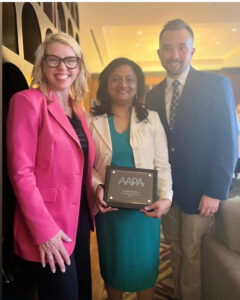
Krishna was named the 2023 American Academy of Physician Associates Student of the Year, an honor presented to her by Rogers at the AAPA’s national conference.
Other leaders on the state and national level took notice of the work Krishna was doing. Patti Cuartas, then president of NYSSPA, encouraged her to run for the New York delegate in the AAPA house of delegates, and Dr. Raquelle Akavan ʼ24 DMSc, founder of PA Moms, encouraged her to run for vice president of PAs for Women Empowerment.
Krishna won both of these elections.
A central focus of Krishna’s advocacy has been improving access to care through policy reform. She worked to support legislation, such as New York State Senate Assembly Bill A7988, that would remove outdated supervisory requirements for experienced PAs, allowing them to practice at the top of their license after completing required clinical hours.As evidence of the need for reform, Krishna points to long wait times for specialty care, particularly in rural and underserved areas.
“If you need these supervision roles, they dictate who you see and who you don’t see,” Krishna said, adding that patient access is blocked by “administrative red tape.”
“Letting PAs practice at the top of their license and removing these supervision requirements would actually help the American healthcare system,” Krishna said. “It would improve access. It would reduce cost. The insurance premiums, everything would go down. We are the solution.”
As Lynchburg’s Advocacy and Research Fellow, Krishna will help translate those real-world challenges into scholarly work and policy-informed dialogue through the Lynchburg Journal of Medical Science and related DMSc initiatives.
She will begin the fellowship and DMSc program in January. During her time at Lynchburg, she will be mentored by DMSc faculty including Akavan and Dr. Sandra Keavy. She hopes to further refine her ability to engage legislators, stakeholders, and professional audiences with clarity and purpose.