Dr. Paul McClure, associate professor of sociology at the University of Lynchburg, is working with a team of university researchers from across the country on a project they hope will positively impact U.S. factory workers and the nation’s manufacturing industry.
The four-to-five-year project, “Custom Product Manufacture at Metal Recycling Plants Using Artificial Intelligence, Extended Reality, and Human-Robot Collaboration,” is funded by a $3 million grant from the National Science Foundation.
“It was one of just 16 grants issued by the NSF in the current cycle, under the Future of Manufacturing Research Group, and one of just five grants nationally under its cyber domain,” McClure said.

“My role on the team will be to assess worker perceptions of AI and human-robot collaboration in metal recycling plants.”
In addition to McClure, the team is made up of computer scientists, roboticists, and an economist.
“Our research team wants to explore how recent advances in AI and automation will impact factory workers and to develop novel manufacturing techniques using robots, virtual reality, and AI technologies,” McClure said.
“We’re working to understand metal recycling plants better. Traditionally, the metal scrap that goes into recycling facilities is sent overseas. So, our team wonders if we can implement technologies that will bring manufacturing into those plants.”
For the time being, he added, the team’s focus is not to look at specific products that could be made in these plants, but to “understand whether the technologies we use will empower workers or threaten their autonomy and dignity.
“We’re quite concerned about workplace boredom, isolation, burnout, and anxiety related to new technologies, and my work as a sociologist on this project is to better understand the dynamics of human-robot collaboration.”
McClure became involved in the project in 2023, when a paper he published in 2018 caught the eye of two computer scientists, Dr. Natasha Banerjee and Dr. Sean Banerjee, who were then on the faculty of Clarkson University in upstate New York.
McClure’s paper, “‘You’re Fired,’ Says the Robot: The Rise of Automation in the Workplace, Technophobes, and Fears of Unemployment,” was published in Social Science Computer Review.
“Most of my work focuses on religion, technology, and culture,” McClure said. “This was my only paper that looked at technological unemployment and fears of AI — my only paper that explored these kinds of dynamics: fears of AI, technology I don’t understand, losing work because of robots.
“I thought it was potentially a one-off paper at the time, but … it’s been surprising. I’ve had a number of publications in general, but this paper now has 508 citations on it, meaning other published papers that have cited my work. That’s way more than I expected.”

In addition to McClure and the Banerjees, who are now at Wright State University, the research team includes Dr. Maria Kyrarini and Dr. Fatemeh Davoudi Kakhki, of Santa Clara University; Dr. Seth Benzell, of Chapman University; and Dr. Ajit Achuthan of Clarkson University.
Dr. Natasha Banerjee is the project’s principal investigator, and McClure is the co-principal investigator.
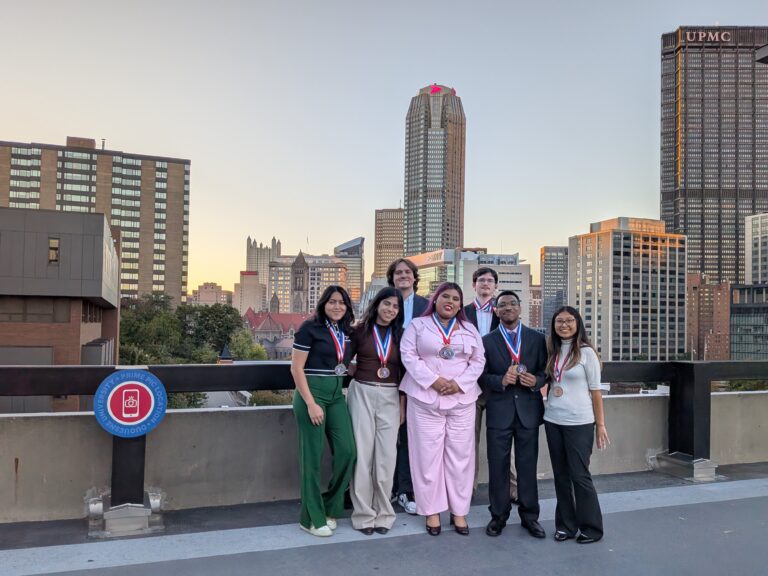
The project was officially launched in mid-September at the International Symposium on Technology and Society, held at Santa Clara University.
At the conference, the research team participated in a panel discussion, and McClure later gave a keynote address, “‘You’re Tired,’ Says the Robot: The Need for Connective Labor in AI Manufacturing Settings.”
At Lynchburg, McClure teaches a DELL Curriculum class called “Humans vs. Robots: A Survival Guide.” The class was included in the team’s grant proposal, McClure said, “as synergistic activities, to demonstrate that you’ve done work previously that can help contribute to the project.”
McClure also suspects the NSF, in considering the team’s proposal, liked the fact that faculty from numerous institutions and from different backgrounds were involved in the project.
Currently, the team meets weekly to plan their next steps, and they’re also planning to collaborate with Chapman University in California on their annual “Chapman Survey of American Fears.”
“We’re working to include some of the variables or questions [from our project] for their next survey,” McClure said in early October. “So, that’s going to help us get started.”
The subaward for Lynchburg amounts to more than $195,000, which will be used for travel and research expenses related to the project, including “course buyouts,” — meaning he can teach fewer classes to allow for more time to work on the project — and also a stipend, so he can continue to work during summer breaks.
“It’s all quite new to me,” McClure said. “It’s wild that this is happening. When I have an article published, I just don’t imagine it making an impact sometimes, or reaching a broad audience.
“So, the fact that a number of people in computer science and artificial intelligence think my work is interesting is really humbling and quite an honor.”