If asked how she came to work in behavioral medicine, Dr. Justice Gray ʼ24 DMSc will tell you, “Psych chose me. I did not choose psych at all, not even a little bit.”
While earning her Master of Physician Assistant Studies at Emory & Henry University, Gray was assigned a rotation at the Southwest Virginia Mental Health Institute, a 179-bed, state-run psychiatric hospital in Marion, Virginia.
Initially, Gray was anxious about this rotation. She was placed on the acute ward, where patients in crisis are given initial assessments and treatment plans are developed. During this time she encountered patients experiencing conditions such as mania, psychosis, and substance abuse issues.
In her first week there, after interviewing several patients, Gray realized she might be suited for this work. “I realized how good I was at talking to people,” she said.
Gray also found strong support and encouragement from her colleagues.
“I had a wonderful mentor, and I was with the team,” Gray said. “We had psychologists. We had multiple nurses, multiple case workers, and social workers. And it was a team that was like, ‘Oh my gosh, you are incredible.’”
Gray was able to connect deeply with her patients, and build the trust that would help them in their long-term treatment.
“I was also able to break the barrier with race because there’s not a lot of people on staff there that are Black,” she said. “Being able to relate to them on certain things and make them smile or make them trust, as well in order to be treated, was extremely helpful.
“I like the very hidden, intimate parts of people, and I feel like those deserve to be heard and healed.”
While she left SWVMHI after her rotation, she did continue working in behavioral medicine.
“I know a lot of people don’t get a passion in their job,” she said. “Sometimes they just have their job and they have their passion. But I get to have both, and I feel … that’s such a blessing.”

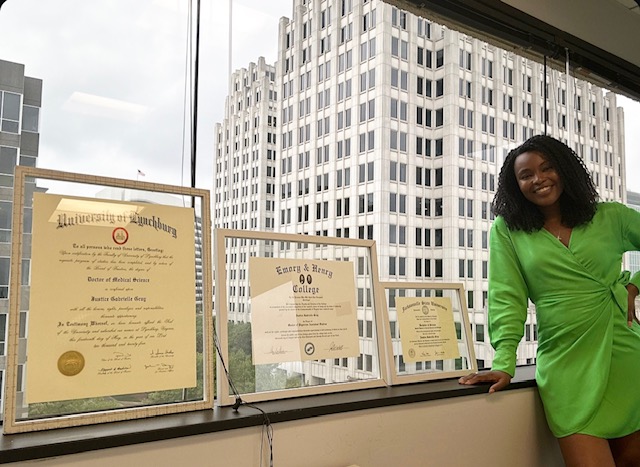
It was Gray’s passion for the field and a desire to eventually go into academia that pushed her to pursue her Doctor of Medical Science degree at the University of Lynchburg.
“I wanted to make sure that I understood medicine, not just being able to practice it, [but] being able to apply it to other things as well, the administrative parts of things,” Gray said.
Gray explained that the DMSc opened her eyes to the gaps in what she had learned in PA school, particularly around leadership and healthcare administration. “I came to Lynchburg and we started our class and I’m like, ‘Whoa, there’s a lot that I don’t know,’” Gray said.
She added that before starting Lynchburg’s DMSc, she had begun to feel limited by what she thought a PA career could be.
“For the longest time, I felt kind of in a box of being a PA,” Gray said. “[Now] I don’t feel like it’s just me in the clinic or just me in a hospital. I feel like it’s me within the world — that I could have a worldly impact.”
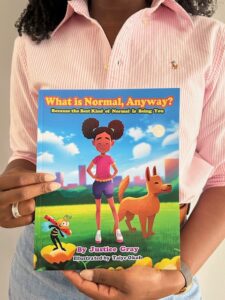
For Gray, having that “worldly impact” led to her first children’s book, “What is Normal, Anyway?: Because the Best Kind of Normal is Being You.”
As part of her current role as a psychiatric physician assistant for Bloom Health Centers, which has locations in Washington D.C., Maryland, and Virginia, she works with children who are neurodiverse and/or have mental health disorders or disabilities.
Concerned parents often ask her, “Is this normal?” and Gray typically responds by asking them to “define normal.”
“It’s just what you choose to feel good about,” she says. “That’s what is normal.”
She said the children she works with often struggle with self image and that she wanted to create something they could relate to.
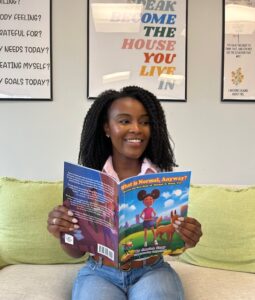
“It’s [like] how we talk about when people of color are misrepresented or underrepresented,” Gray said. “It’s like that when it comes to children in the mental health field. So I just wanted them to see themselves in a book and have fun and not be a one-size-fits-all kind of thing.”
The book’s main character, a young girl named Kacey, was inspired by Gray’s sister by the same name. In the book, Kacey struggles to fit in because of the different ways she experiences the world as a girl with anxiety and Attention Deficit/Hyperactivity Disorder.
According to the book’s synopsis, “This heartfelt tale explores the experiences of children living with anxiety and ADHD, showing that ‘normal’ isn’t about being the same as everyone else. It’s about finding comfort in your own skin, courage in your own voice, and joy in being exactly who you are.”
Although real-life Kacey has Obsessive-Compulsive Disorder, Gray felt that it was important to represent the experience of girls with ADHD in her book.
“ADHD just gets completely misdiagnosed, or girls don’t get diagnosed until way later in adulthood, sometimes in college, because they’re like, ‘Oh, no, it’s fine. You’re fine. It’s just anxiety,’” Gray said.
She wanted her book to make it “very clear that it’s ADHD and anxiety.”
Gray sees her book as a new way to advocate for children and families, carrying her work in behavioral medicine beyond the clinic. She credits Lynchburg’s DMSc program with giving her the perspective to take that step and the confidence to turn her ideas into action.
“[The DMSc] taught me to go beyond the traditional roles of what I’m supposed to be as a PA,” Gray said. “Writing a book may not be the typical next step for a PA, [but] the program gave me the courage to create a vision and bring it to life.”
Gray’s book, “What is Normal, Anyway?: Because the Best Kind of Normal is Being You” can be purchased on Amazon.