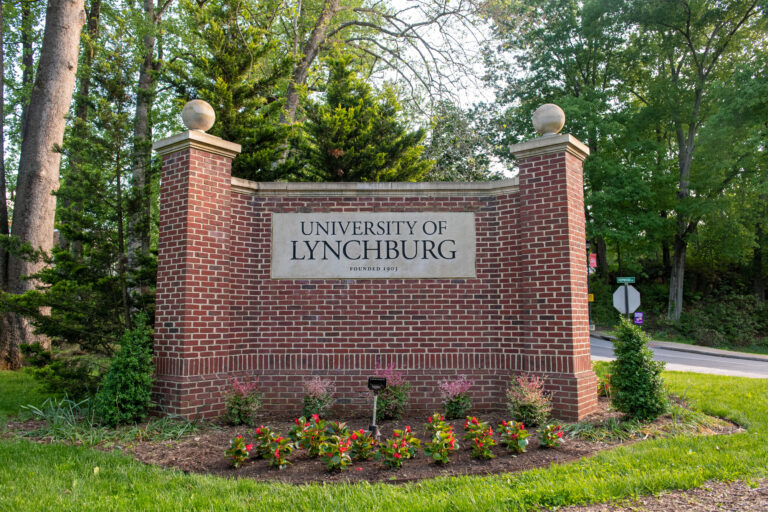
An alumnus and longtime employee of the University of Lynchburg has announced that he will leave his entire retirement account to the University.
“I just wanted to say how much I appreciate the 30 years that I’ve been here and continue to be here and will stay here,” the donor, who has asked to remain anonymous, said in February. “I decided … that I’m going to leave my entire retirement here at the college.
“Since we’re talking numbers, it’s valued — at this point — at $1.2365 million.”
The donor is a two-time graduate of Lynchburg College, now the University of Lynchburg, where he also ran track and cross country. He was a nontraditional student, arriving at Lynchburg in his mid-20s after two previous stints at college and some time spent in the construction industry.
“There was a lot of support as soon as I got here,” the donor, who has dyslexia, said. “That’s why I felt comfortable enough to be an English major.”
He recalled a 17th century literature class with Dr. Richard Burke, where they were reading “Jude the Obscure,” a Thomas Hardy novel about a working-class English stonemason who longs to go to university.
“Many of those students could read those books in an hour or two, and it would take me a couple of days to get through a book, and that’s reading straight,” the donor said. “But I pulled so much imagery from it because I had to read every word.
“One thing that Dr. Burke was impressed with was the amount of imagery I could pull out of the pages.”
He said Burke also allowed him “as much time as I needed to finish an essay,” adding, “I couldn’t have survived as an English major without that kind of support. And there’s not one professor here that didn’t help support me when they saw that I was genuinely trying.”
The donor also remembers the support he received from Dr. Julius Sigler ’62, ’15 DSc, a fellow alum, longtime physics professor, and namesake of Lynchburg’s Hobbs-Sigler science building. Taking Sigler’s physics class satisfied a science requirement.
“I … thoroughly enjoyed it,” the donor said. “It was the hardest class I took here, and Dr. Sigler was so patient with me — he and Dr. [R.D.] Floyd. I remember Dr. Sigler asked me, ‘Please tell me you aren’t a physics major.’
“I understood pulleys — that made sense to me — and thermodynamics, but when we got to lasers and lenses — that and all those numbers and letters — I just started getting lost.
“But he was so patient, like the grandfather I never had. He … explained things over and over, until I finally got it. He was very much hoping this wouldn’t be my major. I don’t think he wanted to have office hours that much with me. One semester with me was enough.”
After graduating from Lynchburg, the donor left for about a year but then returned to campus to work in various capacities for the athletics department. He helped coach the track team, line fields, and managed sound equipment.
Over the next few years, he also worked on Lynchburg’s summer conference crew, was the purchasing agent for dining services, and worked in enrollment. Since the early 2000s, he has worked in the Office of Advancement, and along the way, he also earned a master’s degree in nonprofit leadership studies.
The donor has been at Lynchburg, in one role or another — student-athlete, coach, employee — for over 32 years now. He said he knew “almost immediately,” all those years ago, that Lynchburg was the right place for him, and his decision to make such a significant gift to his alma mater grew out of that lifelong affection.
“I returned to the University of Lynchburg, formerly Lynchburg College, in 1994 after graduating in 1993,” he said. “Throughout my career, I have served in multiple campus divisions, from athletics and dining services to enrollment, and now in advancement as senior director of development and alumni relations.
“As a major gifts officer, I have had the privilege of meeting with thousands of alumni, listening to their stories about how they discovered Lynchburg and how the University transformed their lives. Many even found the love of their life here.
“Most of these alumni, though not ultra-wealthy, gave generously to the institution. For those unable to give a large gift during their lifetime, many ensured Lynchburg was remembered in their estate plans. This thoughtful generosity left a profound impact on me, and I’m grateful to be able to do the same.
“Knowing the University will be in a stronger financial position after I’m gone brings me great satisfaction. Lynchburg has been and always will be my family, and while I may never meet the students, faculty, and staff who benefit from my contributions, it brings me joy to know the institution will thrive long after my years.
“I’m proud to have played a small part in making that possible.”