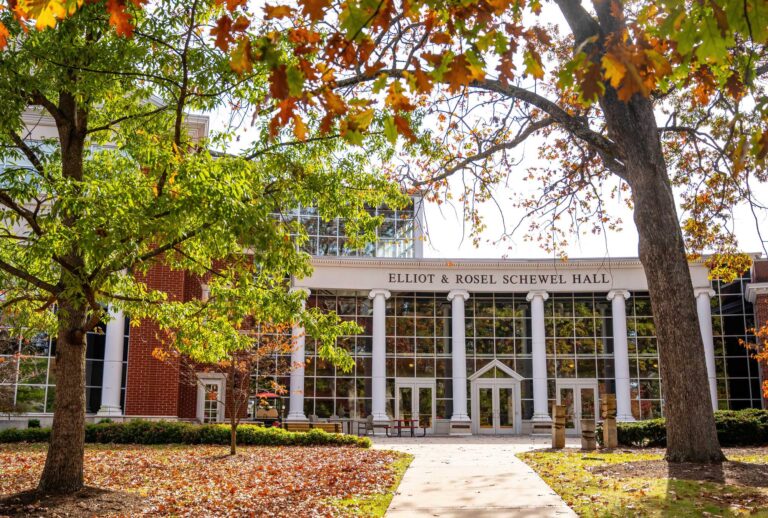
On Oct. 16, the city of Lynchburg released a statement that it had “reached the end of major construction for the College Lake Dam Removal & Stream Restoration Project.” Construction on the area, which is owned by the University of Lynchburg, started in 2020 and involved removing the dam and turning the lakebed into a wetland ecosystem.
The city’s statement specified there are “some minor final items that need to be completed by the contractor” but that they plan to celebrate the project’s completion in the spring.
Erin Hawkins, water quality manager for the city, said the yet-to-be-scheduled spring event will be a “ribbon-cutting” to acknowledge the work that has been done. Stakeholders from the University, city, and Virginia House of Delegates will be invited.
The celebration will put a cap on the eight-year, collaborative project, involving the University, the city of Lynchburg, and private engineering group AECOM.
The goal was to create a sustainable alternative for the old College Lake Dam. It’s the latest chapter of a story that began more than 90 years ago.
College Lake was created in 1934 with the construction of College Lake Dam. According to Dr. Laura Henry-Stone, associate professor of sciences at the University of Lynchburg, the lake itself was created for aesthetic and recreational purposes, and the dam was to be part of U.S. 221, also known as Lakeside Drive.
But there was a problem: The area where the new lake had been created contained a large amount of sediment, which was a flood hazard. Over time, with the accumulation of this sediment, the lake’s area shrank from 45 acres to 14.
On Aug. 2, 2018, College Lake overflowed the dam. For two days, residents collectively held their breath amidst fears that the earthen structure would burst. Although a subsequent inspection by the city showed there was no immediate risk of the dam breaking, it had become clear to all parties that it was time for something to be done.
Because the lake was owned by the University and the dam was city property, a partnership between the two parties naturally formed.
Henry-Stone was heavily involved with the project from its beginning. The same month the lake overflowed, former University president Dr. Ken Garren asked her to be his liaison with the city. Garren knew that Henry-Stone had long advocated for the area to be turned into a wetland ecosystem.
“He told me, ‘I understand that you think a wetland ecosystem in that old lake bed is a feasible option [so] go ahead and pursue that vision with the city,’” Henry-Stone said.
Throughout the project, she met with University stakeholders and city water department employees on a regular basis. The initial plan was to simply drain the lake. However, it soon became evident that would not be a lasting solution.
The dam’s spillway, for example, was an old, hand-cranked gate that, once opened, could not fine-tune the amount of water coming through. Compounding the issue from a public safety perspective, Lakeside Drive’s traffic was being rerouted through nearby Moorman’s Road, causing congestion.
Henry-Stone said there were “all kinds of engineering reasons” for not simply draining the lake, and it was eventually decided that the dam should be removed permanently.
To this end, Henry-Stone and Garren met with members of the Virginia House of Delegates and successfully secured funding for the project. After that came the search for an environmental engineering firm to do design work.
“I reviewed all those applicants,” Henry-Stone said. “I was at the table when we interviewed those different engineering firms that helped the city decide we were going with AECOM.”
Henry-Stone said the project eventually became her main focus.
“I was actually on sabbatical in the fall of 2018, and I had a whole different project in mind, but this basically became my sabbatical project.”
For Henry-Stone, the project was about advocating for the needs of the University, as well as building a sustainable ecosystem for the community.
“My expertise is in sustainability, which is really not just about environmental issues, but also economics and social dynamics,” she said. “I was thinking about things from the city’s perspective, the public’s perspective, [and] from the long-term perspective of the University.”
Henry-Stone also sees the area as an ideal place for student research. This fall, she partnered with the city of Lynchburg’s parks and recreation department to help teach one of her classes.
“[Parks and rec is] conducting invasive species mapping in a couple of different city parks to help inform a sort of restoration and stewardship plan for a couple of the city parks — Ivy Creek and Perrymont,” she said.
“So, my students actually learned … the protocol to do that mapping, and then we tried it out in the wetlands, and we confirmed that there are already a lot of invasive species in the forested margins around the project area.”
According to Assistant Vice President of Operations Michael Vaughan, the University remains in contact with the city “as far as the scope of repairs that will be done to University property,” and the city will come back in the springtime “to do a series plantings” for erosion control.