
Overview
What is a brand?
It’s more than a logo, a slogan, a mascot, or an ad campaign. It’s long-lasting, with enduring strength.
A brand is:
- The promise we make to our audiences.
- The essence of our organization.
- The experience we create.
- The personality we convey.
- The message we deliver.
- The identity we express.
Our Brand Pillars
Learning
At the University of Lynchburg, we believe that learning is a lifelong journey. We are committed to providing our students with a rigorous academic experience that will challenge them to think critically and creatively. We also believe that learning should be engaging and relevant to the world around us. That’s why we offer a wide range of courses that explore the big questions of our time, from the humanities to the sciences.
Balance
We believe that a well-rounded education includes both academic and personal growth. We want our students to be challenged intellectually and to be well-rounded individuals who are prepared to make a difference in the world. We empower our students to be good souls who are committed to making the world a better place.
Community
We believe that community is essential for a fulfilling life and that a strong community is supportive and welcoming. We want everyone to feel like they belong, and we want them to be able to connect with others who share their interests and values. We also want our community to be inspired to make a difference in their communities. We believe that everyone has the power to make a difference, and we want our students, faculty, and staff to be leaders who inspire others to do the same.
Our Brand Personality
Our brand personality defines what it feels like to interact with our University. It’s how we convey our institution’s character to our target audiences. Simply put, it’s the personification of our brand.
Who we are today
Unassuming
We don’t do it for the praise. We do it for the pride.
Synergetic
We lift others as we climb.
Personal
We care for each individual and what lights their soul on fire.
What we will become tomorrow
Loving
It’s what moves us and the world forward.
Empowered
We are always becoming.
Focused
We can see the bigger picture and greater impact.
Our Brand Story
The University of Lynchburg was founded in 1903 with a simple mission: to provide students with a high-quality education that would prepare them for success in life. Today, we are a vibrant and diverse community of learners who are committed to learning, balance, and community.
Our product is our education, which is personalized and student-centered. We work with each student to develop a unique academic plan that meets their individual needs and goals. We also offer a variety of support services to help students succeed, including tutoring, advising, and career counseling.
Our target market is students who are looking for a high-quality education that will prepare them for success in life. We believe that our students are drawn to us because of our commitment to learning, balance, and community.
We believe that our University and our students are a powerful force for good in the world. We are committed to helping our students to succeed in life, and we are confident that they will make a difference in the world.
Additionally:
- We are committed to providing students with a high-quality education.
- We believe that learning is a lifelong journey.
- We are a diverse and inclusive community.
What does this webpage do?
As people, we craft our messages based on who we’re speaking to, our personality traits, and the words we choose. The same can be said for a brand.
This webpage defines each component of our brand, to illustrate who the University of Lynchburg is and why it matters to the world. Put simply, this is how we tell our story.
Our Logo
Lynchburg’s identity represents the institution at the most basic, visual level. It’s a signature, a stamp of quality, and a symbol of pride that we can all rally behind. By following a few simple guidelines, we can ensure that our identity remains unmistakably ours.
Our logo is the primary identifier for the University, and it connects all entities within our University. Because it’s a symbol of what we stand for, it should always be treated with respect.
We have both horizontal and vertical versions of the logo, giving us more flexibility in how we incorporate our name into communications. Our logo may only appear in black or white when reversing it on a darker image or photo.
Licensing Information
All University of Lynchburg marks are licensed in partnership with CLC-Learfield Licensing.
Because they’re licensed, you’ll need to use a licensed vendor for any items that use our name or logos/marks. See a list of licensed vendors in this Google Drive folder. When producing art for a product with a licensed vendor, please reference the number of the University of Lynchburg logo/mark you wish to use from this guide of the University of Lynchburg’s logos and marks (PDF).
Contact the Office of Marketing and Communications (MarCom) [email protected] for logo files.




Seal Rendition
The Seal Rendition may be used freely on University publications and novelty items and may be printed in any brand color of choice. When the Seal Rendition is printed in red, it should be matched to our official Pantone 185 color whenever possible.
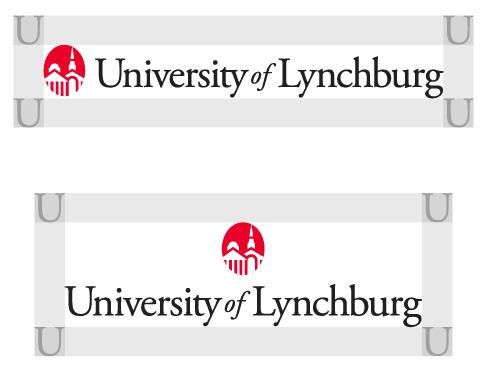
Clear Space
The open area surrounding the logo is based on the height of the capitalized “U” in the word “University,” as shown here. The exact clear space requirements apply to the logo when it is reversed out of a photo or field of color.
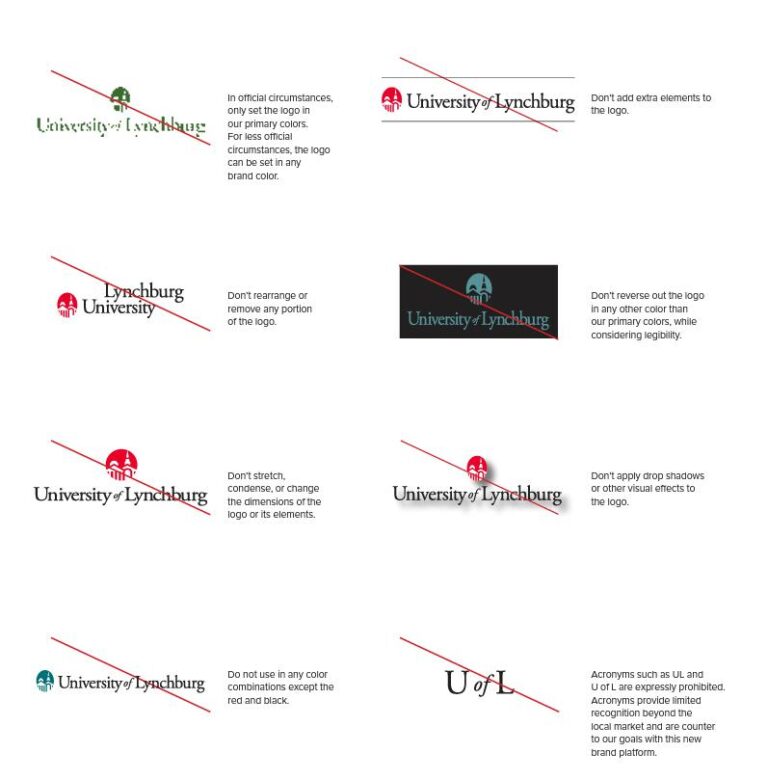
Restrictions
We must remain consistent in how we use our logo. Shown here are some common misinterpretations, which we can avoid by always using the provided artwork without modification.
Our Colors
Our colors say a lot about who we are. They speak to our vibrant community and approach to education. When we vary the combination of colors we use, we can shift the tone of our communications for different audiences.
Primary Color Palette
Although our color system relies heavily on red and white, we recognize the need to incorporate other colors as well. For those circumstances, we’ve developed a complete set of supplementary colors to help meet the demands of a variety of audiences and messages. Our palette represents the vibrant and welcoming nature of our community, as well as our rigorous academic standards and steadfast growth. Lynchburg’s official school colors are Pantone 185 and Cool Gray 6.
Usage Guide
- Do not use tints of any of these colors except Pantone Cool Gray 1 and Black.
- These are the primary options for headline colors.
- Do not use black or gray for a full-bleed color background.
Editorial Style Guide
The University of Lynchburg uses The Associated Press Stylebook as its official style guide. Please refer to the Office of Marketing and Communications Style Guide document for additional guidance.
Social Media Policy
Social media platforms can be useful tools for the University of Lynchburg organizations to communicate with each other and with the public. They allow for the sharing of user-generated content and immediate, interactive conversation. Some examples include Instagram, Facebook, Twitter, YouTube, LinkedIn, Pinterest, Snapchat, TikTok, and Flickr.
The University of Lynchburg Social Media Policy applies to employees and students who use social media for official University purposes.
If you have a social media account that is affiliated with the University, you must register it using our social media registration form.
University of Lynchburg Lexicon
University life can be hectic and confusing, so here’s a glossary of the most commonly used abbreviations and terms. You’ll find these words essential to understanding what goes on at Lynchburg!
Is there something that needs updating or that we left out? Request a web edit.
University Website Guidelines
The University of Lynchburg website is an important marketing tool and means of communicating with the University’s internal and external constituents. Therefore, information posted on the website must be current, accurate, and appropriate for its users. As the University’s online publication, the website must adhere to the University’s official publications policy and style.
Oversight of the University of Lynchburg website is the responsibility of the Office of Marketing and Communications (MarCom).
Authority Over Web Materials
The University reserves the right to regulate and limit the use of web materials that use University resources including the network itself. Such limitations may include, but are not limited to, restrictions on resources such as disk space, material content, and location of information.
Prohibited Web Materials
It is a violation of University policy to place any of the following on a University web server or any web server on the University network:
- Commercial advertisements/solicitations;
- Copyrighted materials without the written permission of the copyright owner;
- Lewd or pornographic materials;
- Other materials that violate local, state, or federal laws or that violate University policy.
Accuracy of Content
Campus entities represented on the website are responsible for keeping them current by sending updates via the website edit request form. The web designer and digital communication strategist reserves the right to remove pages from the University’s website that contain outdated and/or inaccurate information.
Accessibility
The University of Lynchburg website is moving as quickly as possible into compliance with federal accessibility standards as provided in Section 508 of the Rehabilitation Act. New content on the site should comply with these standards. Please refer to About the ICT Accessibility 508 Standards and 255 Guidelines and the W3C Checklist of Checkpoints for Web Content Accessibility Guidelines 1.0 for additional information.
Employee Profile Pages
MarCom will create a profile page for each employee. Please fill out the employee profile request form to request a page.
Profile pages will include:
- Full name and title(s)
- Professional photo (see information about photos below)
- Phone number, email address, and office location
- Clifton Strengths
- Education
- Job Responsibilities
- Short biography (word count limit: 50)
- Specific for faculty:
- Courses Taught
- Research Interests
- Areas of Expertise
Employee Photos
Photos for use in the employee profile (and other University publications) will be a recent headshot of the employee in professional attire, taken on a background furnished or approved by MarCom. The University photographer will take the photos during designated times and will be provided free of charge.
One “re-take” session will be allowed if you are not pleased with the initial photo. If you want a photo taken by a non-University photographer, you must use a MarCom-approved photographer and pay with personal funds.
Hyperlinks
- Links that do not behave as expected (taking the visitor to another web page) will be labeled so the site visitor knows what will happen when the link is clicked.
- The text of an email (or “mailto”) link will be the email address only. For example, an email link for the Office of Marketing and Communications will read “[email protected].”
- No colors or font style will be specified for hyperlinked text.
- New Browser Windows:
- Links to pages should always stay in the same browser window.
- Links to documents, however, such as MS Word or PDF files, should always open in a new browser window.
- Font and Case:
- Font face and size are specified in the University website template and style sheet. Therefore, no font style will be specified within the page content.
- Tags that are approved for use include headers (“h2”-“h6”), “strong” (bold), and, for titles of works, “em” (italic) tags. Heading styles are not appropriate for body text.
- No underlined or all-caps text is permitted.
Images
- Graphics files will be optimized for the web and in JPG, GIF, or PNG format.
- MarCom reserves the right to remove or deny posting images of poor quality that do not uphold the professional tone of the website.
- Webpages should not contain animated images.
Body Text
Webpage text must adhere to the standards for official University publications. Brevity and simplicity of language should be the rule of thumb for text. For ease of on-screen reading, frequent paragraph breaks and lists are used when possible. Remember that website visitors read information that interests them, but they rely on skimming text to find what they’re looking for.
Upcoming or Placeholder Content
Placeholder text, such as “Coming Soon” or lists of links that do not yet go anywhere, will not be published. Such content is unhelpful to site visitors and looks unprofessional.
Sound
No embedded sound is permitted on any official University of Lynchburg page. Links to sound files, however, are allowed.
