When Dr. Bryn Kroto ’25 DMSc reflects on her calling, she often reaches for the image of an arrow. Whether she’s in the emergency department, a war zone, or a rural Guatemalan clinic, her gift is finding the most urgent need and aiming directly for it.
This imagery was revealed to Kroto through prayer and inspired the name of her organization, Red Shot Medical, a platform where her clinical expertise, research, and faith converge in service to global health.
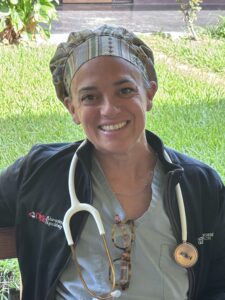
Kroto’s passion for emergency medicine and humanitarian service was sparked long before she founded Red Shot Medical in 2024. With over 25 years of experience in emergency medicine, she began her career in prehospital care as a firefighter and paramedic.
She began working as a physician assistant after completing the PA studies program at Red Rocks Community College in 2010. As a PA, Kroto continued to focus on emergency medicine, eventually serving in surgical, mobile, and flight medicine roles.
Despite having what she described as a “successful career,” “great marriage,” and “great family,” Kroto found herself struggling with extreme depression.
“I had kind of an abusive childhood, and that developed into complex trauma as an adult,” she said. “I got into some really deep counseling and had a lot of memories come back, and processed through a lot of complicated memories and experiences.”
Kroto said she tried everything to address her depression — antidepressants, nutritional programs, exercise, sleep — but nothing she was “supposed to be doing” was bringing her relief. Eventually, she found herself turning to prayer and studying Jesus.
“I came to understand that everyone who came into contact with Jesus who wanted to be healed was healed,” Kroto said. “So, I really got into things like intercessory prayer and spiritual warfare. … There’s good and there’s evil, and evil wants our soul.”
She recognized that evil was attacking her through depression, and even as she built her relationship with God, she struggled with suicidal thoughts.
“I got to the point where I wanted to die so badly. … I actually asked God to give me cancer,” Kroto said, adding that she was diagnosed with breast cancer at age 45 and has been cancer free for five years.
“I was losing that fight because I was trying to fight it on my own. When I started really spending time with the Lord, it began to show me how he can heal me and help me.”
Kroto’s faith became her new foundation. As she pursued new opportunities, prayer became as fundamental to her work as any piece of medical equipment.
In a LinkedIn post reflecting on a mission trip to Kyiv, Ukraine, in 2022, she wrote, “Prayer is the necessary component of mission sustainability. … We had to surrender in our hearts ahead of time. We could not afford to constantly be distracted by fears of what-ifs.
“We had to focus, and in order to fully focus and serve the soul has to know it’s already free.”
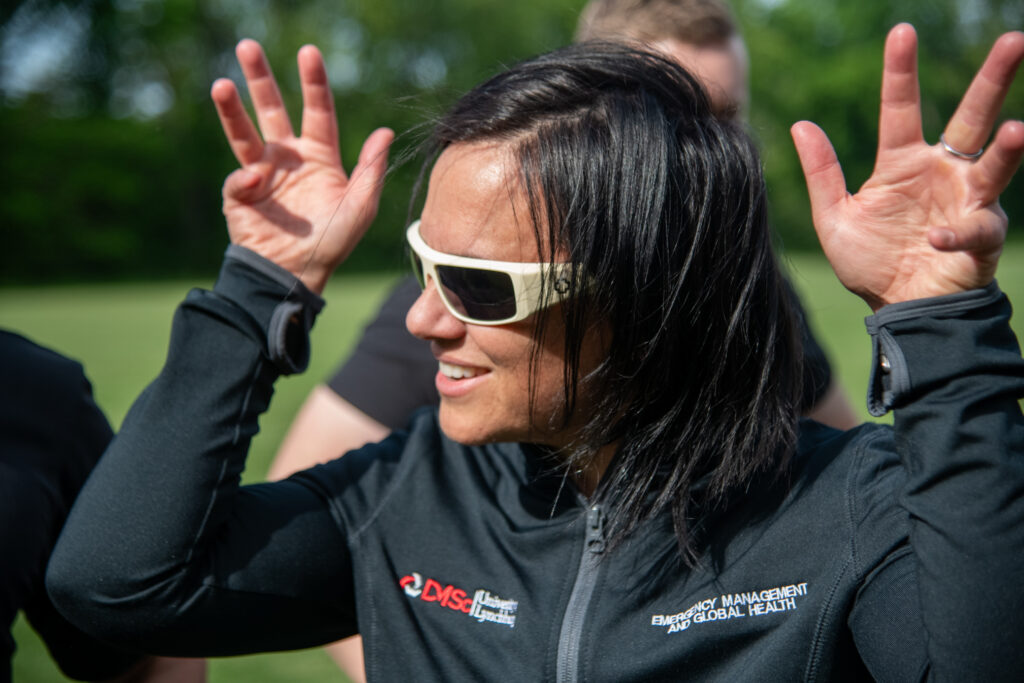
In pursuit of deeper impact, Kroto enrolled in Lynchburg’s Doctor of Medical Science program with a concentration in emergency management and global health. The degree gave her a path to combine her emergency medicine background with research and leadership in humanitarian care.
As part of her doctoral work, Kroto set her sights on a challenge affecting not just her own career, but healthcare systems worldwide — the lack of clarity around the role of PAs.
Compared to other healthcare positions, the PA’s role is relatively new and even controversial. Kroto explained that some physician groups are against the expanding influence and scope of PA practice, while others are welcoming and saying, “PAs are awesome! Give me more PAs’”
Through her research, Kroto realized that while PAs or PA equivalents are employed in more than 60 countries, the profession is categorized by more than 30 titles. Additionally, the role is not recognized by the World Health Organization or listed in the International Standard Classification of Occupations by the International Labor Organization.
For Kroto, the implications were urgent. Without a unified identity, she said, PAs risk being excluded from career advancement and global work at the very moment the world faces a projected shortage of 10 million healthcare workers in the next decade.
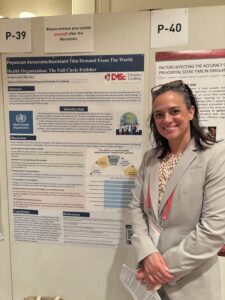
“If we don’t know what to call ourselves, and we’re having … an identity crisis within our own profession, then nobody else is going to continue to call on us. I think there’s a knowledge gap in terms of how we really sell ourselves.”
In May, Kroto presented her research at the World Association for Disaster and Emergency Medicine’s Congress on Disaster and Emergency Medicine in Tokyo, Japan.
She emphasized the need for unity and PA recognition on a global scale, as well as the valuable role PAs can play in emergency situations when allowed to function in “forward environments” and make “high-level decisions.”
“The standard on an international scale for triage is really at the level of the PA,” Kroto said. “It’s actually higher than nurses, although nurses are good at it. [But] even emergency and critical-care nurses, they just don’t have the level of expertise that the world situation is demanding.”
While completing her doctorate and research, Kroto founded Red Shot Medical in June 2024. It began as a practical structure for her clinical and research work, but it quickly became the embodiment of her faith and vision — an arrow aimed at global health needs.
According to its website, the mission of Red Shot Medical is “to create lasting connections through medicine and empower others to step into the world of humanitarian medical missions.” Its vision is to “inspire confidence and clarity for those ready to bring healing and hope to others.”
Through Red Shot Medical, Kroto manages clinical, medical mission, training, and research work as an individual practitioner and builds teams of healthcare professionals to deliver care to “marginalized and displaced persons” around the world.
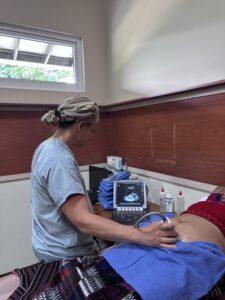
She works closely with pre-established organizations, ensuring she and her teams can have a sustainable, long-term impact on those they work with.
“I’m … shifting to developing humanitarian trips and putting teams together … and coming alongside pre-established clinics and helping build them up,” she said. “It really has that sustainability component to it.
“It’s good for the local community, but it’s also good for young clinicians who are looking to get involved in training missions for the first time.”
In July, Kroto led a medical mission team to Guatemala, where they worked with Adonai Hospital, a small local hospital managed by Adonai International Ministries.
Her team included a variety of healthcare providers and students, including what she described as a “27-year paramedic/officer, an Air Force nursing student, a 7-year med-surg RN, and a dedicated pre-med student.”
The team also included two PAs, two physicians, and an engineer.
The trip allowed her to pilot her “top five, keep ʼem alive” skills training with local providers. These critical skills included two methods for bleeding control, effective CPR, basic airway management, and identification and needle decompression of a tension pneumothorax.
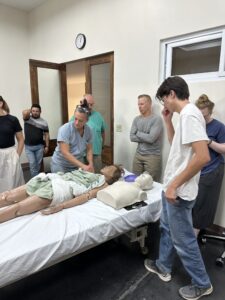
“[These] are five basic skills that are truly lifesaving, that are very easy to learn, that are easy to apply, [and] they are very low-equipment,” Kroto said. “They are vital in terms of sustaining life until someone can get evacuated.”
By training local providers in these types of critical but low-equipment skills, Red Shot Medical makes a more sustainable impact. The equipment used is small, easily fitting into a fanny pack or backpack, and is easily accessible through donations.
“They needed it, they loved it, [and] they want more,” Kroto said. “They want us to continue to develop ongoing education for them. And so I would like to help fill that gap. … We’re not creating a dependence on us by teaching many of these skills. We’re truly giving this over to them.”
Reflecting on the purpose of Red Shot Medical, Kroto explained, “I wanted to … go from place to place, from clinic to clinic, and say ‘What do you need and how can I get it to you?’”
For Kroto, the path ahead is both clear and expansive. She envisions Red Shot Medical as a hub for global clinicians looking for resources, community, and ways to make a sustainable impact.
Every step — from emergency rooms to academic conferences, from active war zones to Guatemalan clinics — carries the same guiding force: faith sharpened by experience, research grounded in advocacy, and a commitment to target what matters most.
To learn more or support Red Shot Medical, visit its website or email Kroto at [email protected].