There were many things Michael Guertin ’27 MS loved about his time in the U.S. Army Reserve: the structure, the “discipline [and] resolve to push through accomplished tasks and objectives,” and how it taught him to “work with people of all different creeds, ethnicities, and backgrounds, and coalesce around mission objectives.”
“I loved everything about that,” Guertin, a student in the University of Lynchburg’s Master of Science in Clinical Mental Health Counseling, said. “I loved the drive that it fosters within you, but … that can be a double-edged sword.”
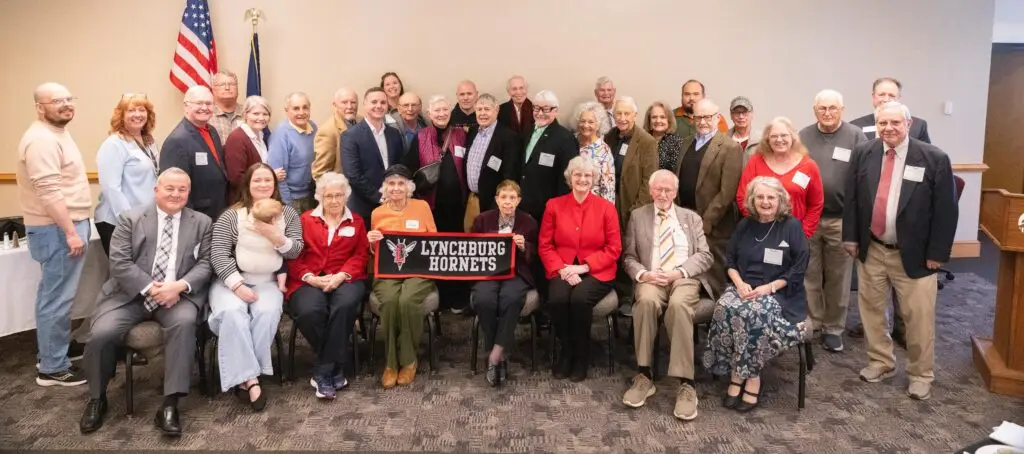
On Tuesday, Nov. 11, Guertin was the keynote speaker at the University’s annual Veterans Day luncheon, an annual event sponsored by Lynchburg’s alumni and veterans affairs offices.
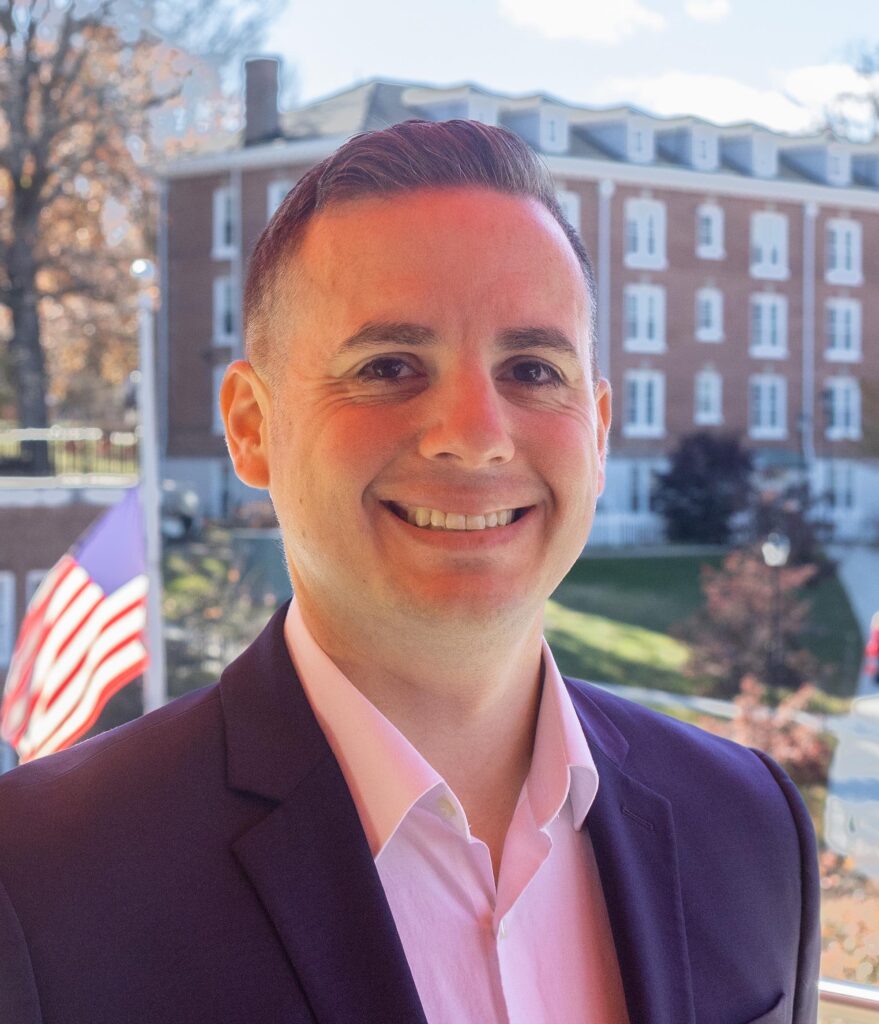
In his speech, “Reframing Strength: A Veteran’s Journey to Healing and Service,” Guertin talked about his 13 years in the U.S. Army Reserve, during which he served three overseas tours: one in Iraq and two at the U.S. base in Guantanamo Bay, Cuba.
While Guertin was awarded numerous medals for his service — the Army Achievement Medal, Army Commendation Medal, Global War on Terrorism Medal, and others — he was quick to say “I am no hero.”
He added, “I stand before you today, hoping that my story can advocate for veterans and others to seek the help and support they need and deserve. I invite you to walk this journey with me.”
Guertin grew up in New York’s Hudson Valley, where he played sports, served in his Catholic church, and was an Eagle Scout. “Throughout my childhood, I always looked up to men and women in uniform because of the ideals that they represented,” he said.
“After all, the Gospel teaches us that there is no greater love than to lay down one’s life for one’s friends. Because of my faith and the strong foundation my family provided, I was eager to join them and be ready to serve my country.”
After graduating from high school, Guertin joined the U.S. Army Reserves. He completed 18 weeks of basic training and military police school, where he was his company’s honor graduate. “I was eager to report to my unit and stand at the ready,” he said. “Little did I know that some of what made me a soldier would also bring a great deal of pain.”
Not long after he finished his training, Guertin was deployed to Iraq. There, he said “my faith was shaken and stripped from me due to various traumatic experiences.”
While serving in the Iraq War, Guertin’s unit crossed a suspected minefield to search a house for weapons, and on another occasion, their convoy nearly missed an improvised explosive device, or IED.
His war experience, including exposure to toxic burn pits, left him suffering from post-traumatic stress disorder, chronic back pain, fatigue, and other issues.
“Regardless of the struggles, we were conditioned to suppress our emotions, fatigue, and pain,” he said. “Admitting weakness felt like a betrayal to those who couldn’t return home. I returned home a different person, and I ignored and buried the invisible conditions I struggled with, and still do to this day.”
Guertin was deployed to Guantanamo Bay in 2013 and again in 2016. In 2020, he left the military. Eventually, he found work in the private sector as a project manager.
When his wife, Emma, became pregnant with the first of what would be three sons, he started to realize that what he describes as the “trauma I had buried so deeply” was impacting not only him but his family and other loved ones.
After having surgery for his debilitating back pain, Guertin said he “hit rock bottom.”
“[Emma] implored me to consider a career change, since my current path was unsustainable,” he said. “As I reflected, I realized I was fighting an internal battle against unrealistic and harmful norms, clinging to ideals and standards pushed throughout my time in the military: stoicism, avoiding pain, pushing through hardship, even at great personal cost.
“However, I knew I had to address my issues head-on for my family, my wife, my sons, and, most importantly, myself. For many years, I’ve struggled with survivor’s guilt, questioning why we survived after so many close calls and others didn’t.
“Ultimately, I realized the best thing I could do is redefine what strength meant and honor those who couldn’t come home by living life fully and doing all I can to help myself so I could help others.”
Guertin sought counseling, rediscovered his faith, and found his purpose.
“More than 20 years ago, my spiritual director explained that a career is what you do to punch a time card and get paid,” he said, “but a vocation is what you feel called to do, based on your strengths and talents.
“As I was actively considering other paths, it just so happened that one of my friends, who is a therapist, suggested I consider counseling. The more I reflected and prayed about the idea of pursuing this field, the more I realized that it would allow me to advocate for others to seek the help they need and reframe what it means to be strong.”
The University of Lynchburg celebrates its U.S. military veterans and the local veteran community each Veterans Day. Over the past two decades, this has included lunches, dinners, musical performances, speakers, and other events. During the COVID-19 pandemic, when events could not be held on campus, care packages were delivered to local veterans.