
Do real research as an undergraduate
CURE courses let you take part in real research as part of a regular class. Instead of only learning about research, you help create new knowledge in your field. In a CURE, you work closely with a professor on a focused research question. By the end of the semester, your work will contribute to a larger scholarly project.
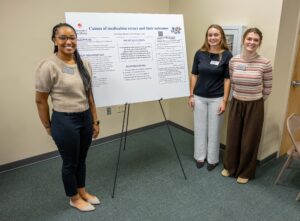

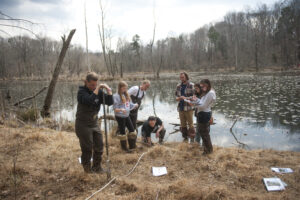
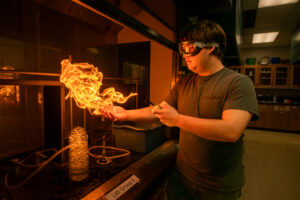

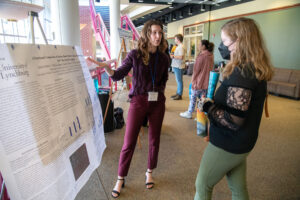
What is a CURE course?
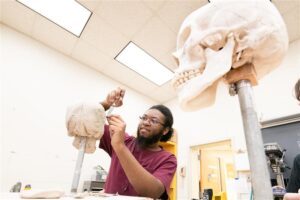
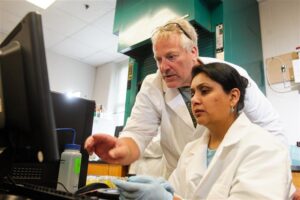
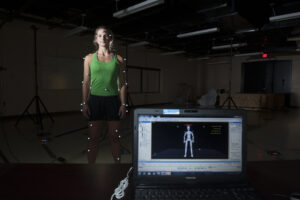
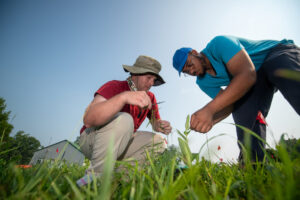
A Course-Based Undergraduate Research Experience (CURE) is a class built around a professor’s active research project. You and your classmates function like research assistants. You learn how to do a scholarship by actually doing it. Unlike traditional research methods courses, which often survey many approaches, CURE courses go deeper into the specific methods needed to answer one focused research question.
Credits for CURE courses may range from one to four hours, depending on the scope of the project. Most students at Lynchburg earn three credits for a CURE.
What will you do in a CURE?
CURE courses include:
- Collaborative teamwork
- Shared inquiry and discussion
- Data collection and analysis
- Literature review
- Developing and refining research questions
- Producing work that supports a faculty member’s scholarly goals
Your specific tasks depend on the discipline. You might:
- Collect data
- Analyze primary texts
- Work in a lab
- Use software or research tools
- Contribute to writing or presentation preparation
Why take a CURE at Lynchburg?
At the University of Lynchburg, CURE courses are open to students of all majors and classifications, from first-year students to seniors. Some sections may have prerequisites, so check with your advisor.
Benefits include:
- Earn academic credit (typically three hours)
- Work in small classes with direct faculty mentorship
- Build strong research, writing, and critical thinking skills
- Contribute to projects that may be presented at the Student Scholar Showcase
- Strengthen your résumé with real research experience
- Gain confidence and professionalism for graduate school or careers
CURE courses are designed to move faculty research forward while giving you hands-on experience in the process
Spring 2026 Courses
Political Science
Students in political science are assisting Dr. Tim Meinke in answering the research question: “Why Do the States Make Different Choices on Welfare Policy?”
Students are collecting data for all 50 states from 2023 on all nine independent variables used in their 1997 study of state welfare reform.
Biology
Students in biology are helping Dr. David Freier on a project entitled “Investigating Macrophages.”
Fall 2026 Courses
Education
From Talk to Text: Can Self-Regulated Strategy Development Be Adapted for Preschool Writers? (Dr. Stefanie Copp)
Biology
Characterizing Our DNA Exceptions (CODE): A Bioinformatics Approach to Understanding Genetic Variants of Uncertain Significance (Dr. Jamie Brooks)
English
“Modernist Writers, Gardens, and Creative Restoration,” led by Dr. Meghan McGuire (English).
How to Register
CURE courses appear in the course catalog with specific prefixes. Because each section is built around a unique faculty project, details may vary.
Steps to enroll:
Review prerequisites in the course listing.
Talk with your academic advisor.
Confirm whether the course is cross-listed for your major.
The research center also publishes a bulletin of approved CURE sections before advising each term
Interested in Teaching a CURE?
Faculty design each CURE around a focused research goal. Proposals are submitted to the Research Center and reviewed by URC Research Fellows
Proposals typically include:
- A section-specific course description
- A statement explaining how the course supports the faculty’s research agenda
- A credit hour calculator
- Departmental approval
- A direct-cost budget request
- An updated CV
Workshops and professional development sessions are offered to support faculty preparing a CURE
Have Questions?
For more information about CURE courses or upcoming offerings, email [email protected].
