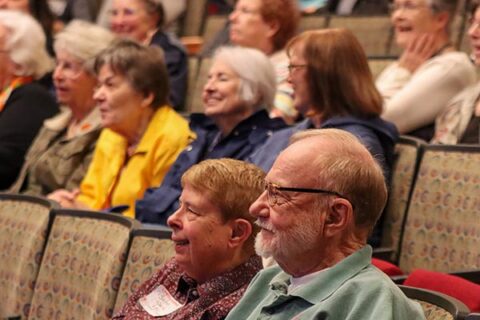

"I really love all of it! I love learning about our area, the strong substance of the talks, the chance to meet new people, the question-and-answer session, and the respect given to the time. It is a lot of fun and I have been recommending it to anyone I see."

Engaging. Educational. Community.
LIFE@Lynchburg
Learning and Community
The University of Lynchburg’s LIFE@Lynchburg program offers not-for-credit learning opportunities for community members aged 50 and older.
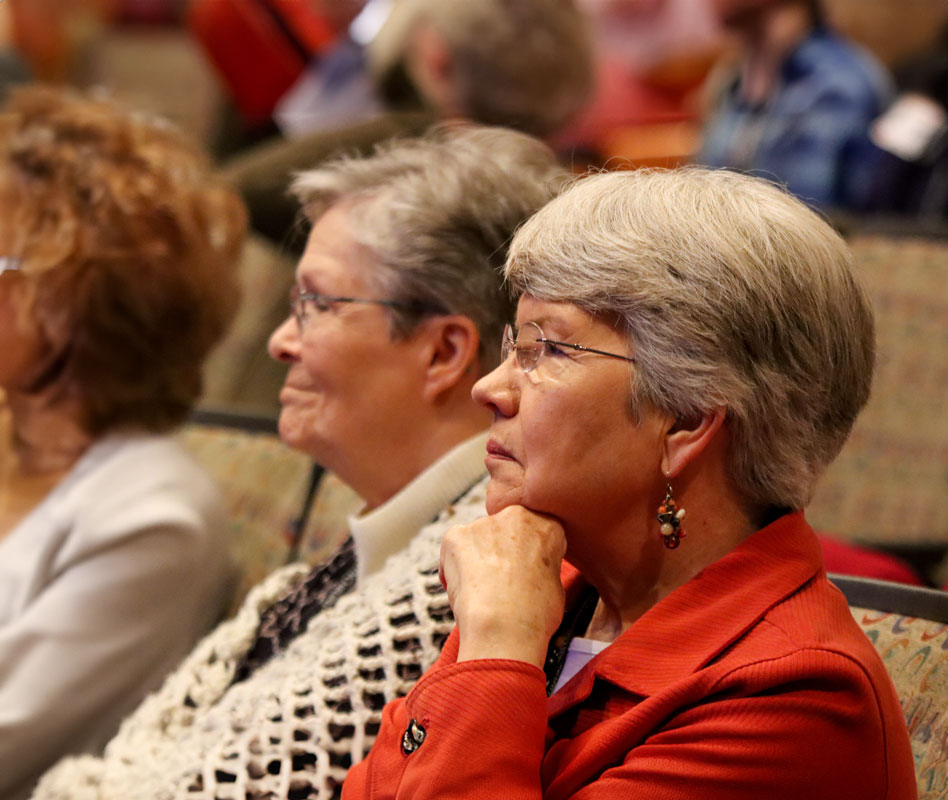
The University of Lynchburg’s LIFE@Lynchburg program offers not-for-credit learning opportunities for community members age 50 and older. Ultimately, the program is a community of lifelong learners who explore topics together and do what the University of Lynchburg is known for — building friendships and connections that last a lifetime.
The program features weekly presentations on a variety of engaging topics, taught by current and retired faculty and staff members or area educators and presenters. Ten classes are offered each semester (fall and spring), with occasional field trips during the semesters and over the summer. LIFE@Lynchburg is for people who love learning, want to dig deeper in their areas of interest, or discover something new.
With LIFE@Lynchburg, you’ll learn about history, science and technology, arts, culture, politics, and more. The program is open to residents of the surrounding community, as well as alumni and existing Lynchburg friends and family! There are no requirements or prerequisites, only that you’re ready to dive in, learn about and discuss interesting topics, and make some new friends along the way. Also, after the presentations, you can eat lunch, get some coffee, or hang out with one or more of your new friends at Lynchburg’s dining facilities!
"Engaging presentations!!! What a wonderful opportunity to learn without the homework!"
"I know a lot of history but through these interactive experiences, the history comes alive."
"[I love] the opportunity to continue to learn at the University at such an affordable cost."

The Details
What it costs:
- Annual membership: $150
- Semester membership: $85
- Single event pass: $12
- Annual virtual membership: $79
- Semester virtual membership: $49
- Premium membership: $1,000
- Lifetime membership: $2,000
Our payment and membership options and benefits provide access to a range of on-campus amenities.
When it starts:
- Spring 2026 sessions begin on Jan. 28, 2026.
- Wednesdays 10 a.m. – noon
What you get:
- Attendance at 10 in-person, two-hour interactive sessions held on the University of Lynchburg campus (typically in Sydnor Performance Hall, located in Schewel Hall).
- Reserved parking on Wednesdays.
- Access to live recordings after the event via an emailed link.
- Free tickets to theatrical and musical performances on campus are available for annual and semester members.
- Borrowing privileges at Knight-Capron Library: Check out books, audiobooks, magazines, and DVDs, and use the library’s public spaces.
- Lunch in Burton Dining Hall on Wednesdays at the student price
Curriculum
The LIFE@Lynchburg curriculum varies by semester and is shaped by suggestions from our members. History, arts and culture, science and technology, the environment, and politics are just a few topics we will cover in 2025-26.
We want to know what interests you and what you’re passionate about. Have an idea for a topic? Let us know.
Spring 2026 Course Lineup
Thou Shalt Not Suffer a Witch to Live”: Connecting the Dots Between McCarthyism, Lucille Ball, and Me — Jan. 28
What I thought I knew about the infamous Salem Witch Trials wasn’t the whole story at all. In fact, my knowledge barely scratched the surface. All I knew was that a group of foolish teenage girls let a prank get way out of hand — and that a famous playwright named Arthur Miller had decided to create an extended metaphor to spotlight the McCarthy trials. Of course, as an English teacher, I had taught Miller’s work, The Crucible, many times. I thought it was a noble attempt to focus on man’s inhumanity to man in a way that would surely prevent us from doing such a heinous, cruel thing again. Boy, was I wrong. Add grievously uninformed. While I knew all of Miller’s characters by heart, I did not know that my 9th great-grandmother, Mary Towne Easty, would be among those to meet their end at the end of a short noose.
I had just begun researching my genealogy when I connected with a long-lost cousin who shared my branch of a vast tree and offered me a copy of the extensive genealogical report she had commissioned some years back. On a dark and stormy night (yes, seriously!), I lay in bed and perused the stack of pages. There were names I recognized. Connected to more names. All documented, of course. By now, I wasn’t recognizing names at all — only the events that connected their lives across generations. This person married that person… and gave birth to the other person… Line by line, I followed the unfolding story with my finger. Eventually, I turned a page, and two names jumped off, names I had seen on Arthur Miller’s pages as well: REBECCA NURSE, my 10th great- aunt … and her sister, MARY EASTY, my 9th great-grandmother. Both were hanged in Salem.
For the next two years, I often dreamed that I was choking. I grew angry every time I saw the silhouette of a Halloween witch. The sight of the Salem Police Department’s official patch — “Witch City”— would drive me into a rage. I became so preoccupied with the event that I could not make sense of it at all. I finally figured that the debt I owed to my murdered ancestors was to examine WHY such a thing had happened fully. And it sure wasn’t what Arthur Miller said.
Speaker Biography:
Donna Plunkett St. Clair is Lynchburg-born and bred. A proud graduate of E.C. Glass High School, she served a tour of duty in the U.S. Army as a journalist and broadcaster during the Vietnam era. Her kind Uncle Sam funded her bachelor’s degree in English from Randolph College (back when it was R-MWC). Years later, she finally completed her master’s degree in communication and marketing at the University of Oklahoma. For many years, she worked in that field, in nonprofits and the government, before returning to her first love: teaching high school English. Having lost her own husband to younger-onset Lewy Body Dementia and Alzheimer’s Disease, she subsequently founded a global social media support group for other caregivers. Today, she spends her time on genealogical research and political activism.
The Business of Magic: The Walt Disney Company's Political and Cultural Economy — Feb. 4
The Walt Disney Company is more than just the ”House of the Mouse” or the “Happiest Place on Earth, it is one of the most powerful players in the global media economy, impacting culture, business practices, and even government policy. This presentation examines the company’s political economy, tracing how it evolved from a small animation studio into an entertainment powerhouse that now controls galaxies and superhero universes.
How does Disney handle changes in the political landscape as it faces headwinds in the United States, including immigration issues that impact tourism and labor in the Disney parks, accusations of politically motivated speech from Disney-owned entities, and shifting cultural norms in its filmed entertainment?
Be our guest in considering how Disney shapes not only the stories we tell but also their distribution and who receives a happily ever after in the global media landscape.
Speaker Biographies:
Dr. Ghislaine Lewis is an associate professor of communication studies at the University of Lynchburg. She completed her undergraduate degree in communication and religion at Randolph-Macon Woman’s College and her Master of Science in journalism from Florida A&M University. Her PhD in media and communication is from the University of Canterbury in New Zealand, and her graduate certificate in higher education is from Monash University in Australia.
This is her ninth year at the University, where she teaches classes in communication and Africana Studies. She is the advisor for the University’s campus newspaper, The Critograph, and is a trainer with the University of Lynchburg’s National Coalition Building Institute team.
Dr. Lewis was also the first executive director of the Pierce Street Gateway and a founding member of the Pierce Street Community Garden. She has also served as board chair for CVANE. She currently serves on the boards of the Blue Ridge Area Food Bank and the Link Project, and on the exhibition committee of the Legacy Museum of African American History.
Dr. Lewis’s love of travel and passion for the classroom have led her to undertake adventures around the globe. Her research interests focus on the linkages among new media, global politics, and policy.
Dr David Richards is chair of the political science program at the University of Lynchburg. The program offers majors and minors in political science, international relations, security studies, and intelligence studies.
Dr. Richards is a graduate of Kenyon College (BA in political science) and American University (master’s degree in American government, PhD in comparative politics). He regularly contributes commentary to Fox News, The Washington Post, US News and World Report, and other media outlets. He is regularly featured for political expertise on WSET 13 in Lynchburg.
He grew up on the Sweet Briar College campus and attended Virginia Episcopal School. He lives in Amherst with his wife and two sons. This fall marks his 18th year at the University of Lynchburg.
Originally from Annapolis, Maryland, Dr. Robinson grew up loving popular culture and followed that excitement through his academic career. Mike earned a PhD in American culture studies from Bowling Green State University, with a specialization in communication and popular culture.
Mike joined the communication studies department in 2000, and he has served as chair since 2016. His recent publications include articles in books on Doctor Who and an entry in the Routledge Handbook of Star Trek. This past spring, his sabbatical project investigated supervillains in the Marvel Cinematic Universe and is expected to be published in October.
Mike enjoys watching TV and movies with his wife, daughter, and son. As you might have guessed by now, he is a science fiction enthusiast and a huge comic book fan.
Pain: The Good, the Bad, and the Ugly — Feb. 11
Dr. Jason Grandeo
Behind The Scenes At The 1996 Titanic Expedition — Feb. 18
Bruce Braun will share his personal experiences as director of television broadcast operations on the 1996 Titanic Expedition, using a PowerPoint overview and a series of video clips. He will provide online-accessible materials and printed materials (books) for the audience to review.
Due to copyright restrictions, this presentation will not be recorded. LIFE@Lynchburg members are encouraged to attend this presentation in person.
Speaker Biography:
Bruce Braun had an extensive and varied career in media. He served as the president of creative teleproductions for the Old Time Gospel Hour for 40 years, worked as an executive producer for Victory Communications, was a producer and director for the Beauty Television Network, worked as the technical coordinator and world network director for Explo ‘85, was the national network TV director for World Vision US & Canada, was a producer and director of communications and general manager for WAFG FM in Fort Lauderdale, consulted for the LTN Network, is the retired vice president of new media communications and executive director of technical operations for Liberty University.
He was the director of broadcast operations for the 1996 Titanic expedition. He has produced and/or directed more than 5,000 live shows and performed as a writer, lighting director, director of photography, segment producer, camera operator, sound engineer, editor, animator, or consultant on over 2,000 shows.
Bruce has degrees and certificates from Fort Wayne Bible College/Taylor University, the Elkins Institute, the University of Southern California, and Columbia College. He has been a professional musician since 1964, and he and his wife, Barbara, also a musician, have lived in Lynchburg since 1978.
Lynchburg and the Vietnam War — Feb. 25
The Vietnam War touched lives at home and abroad. In Lynchburg, families waited anxiously, students debated, and communities faced loss. Twenty-seven young men from our city did not return. Lynchburg Museum Director Ted Delaney will be joined by the museum’s curator, Crystal Diff, researcher Noelle Beverly, and local veteran and POW David Harker for a discussion on the Vietnam War, its connections to Lynchburg, and the research that informed the Museum’s Vietnam exhibit.
Speaker Biography:
Ted Delaney is the director of the Lynchburg Museum System and chief public history officer for the City of Lynchburg, and the former executive director of the city’s Old City Cemetery Museums and Arboretum. Ted has written, lectured, and consulted about local history and genealogy for over 20 years. He currently serves on the boards of Historic Sandusky, Lynch’s Ferry Magazine, and Opera on the James.
Ballparks and Ballplayers: Baseball in Lynchburg, Virginia — March 11
The history of baseball on the Lynchburg campus and in the City of Lynchburg.
Speaker Biographies:
Dr. David Freier
Dr. Stephen P. Smith is a distinguished educator, researcher, and leader in motor learning, strength and conditioning, and sport psychology. Currently serving as the associate vice president for academic affairs at the University of Lynchburg, Dr. Smith plays a pivotal role in strategic planning, curriculum development, and faculty mentorship. His career spans two decades in higher education, athletic coaching, and program administration, with extensive experience developing academic programs and fostering student success.
Dr. Smith earned his Doctor of Education in Motor Learning from the University of Virginia, with his dissertation focusing on talent selection in youth baseball. He also holds a Master of Education in Curriculum and Instruction and a Bachelor of Science in Health, Movement Science, and Recreation from Lynchburg College.
A Certified Strength and Conditioning Specialist and Registered Strength and Conditioning Coach, Dr. Smith has applied his expertise in athlete development, sports performance, and biomechanics. He has held leadership roles as a dean, associate professor, and department chair, and has served as head strength and conditioning coach for multiple collegiate teams. His research, published in the Baseball Research Journal and the Journal of Strength and Conditioning Research, focuses on talent selection, pitching velocity, and strength-training methodologies.
Beyond academia, Dr. Smith has been deeply involved in community outreach and youth sports development, serving as a Little League board member, travel baseball coach, and advocate for fitness and wellness initiatives. He is an active presenter at national and regional conferences, sharing insights on Olympic lifting, sports leadership, and strength-training innovations.
With a passion for mentorship, athletic excellence, and student empowerment, Dr. Smith continues to shape the future of sports science and education through his leadership, research, and dedication to lifelong learning.
Yankee POWs in Lynchburg — March 18
In September 2024, Mac Farland, Inc., published my book, Yankees in the Hill City: The Union Prisoner of War Camp in Lynchburg, VA, 1862-1865, the first in-depth study of this facility. Some authors have mentioned it in a sentence—or at most a paragraph—while others ignore it altogether. The Lynchburg camp differed from other Confederate auxiliary POW camps, like Libby, Belle Isle, Andersonville, Salisbury, or Danville. Union captives who were wounded or ill when they arrived in Lynchburg were triaged and assigned to a hospital, many of which also contained Confederate patients. Those who died while prisoners in Lynchburg were buried by the mortuary managed by George A. Diuguid. Each day, the dead from both armies were collected, placed in coffins, their personal data recorded, and then they were buried in the City Cemetery. There was a daily roster of ministers who held burial services for the fallen from
both armies, and the Confederate government paid all the funeral expenses. This service was available to Black Union soldiers as well as white soldiers. After the war, the remains of some soldiers were returned to their families, while most of the Union dead were moved to Poplar Grove National Cemetery in Petersburg.
With the restoration of peace, the facilities used to care for prisoners quickly returned to their previous functions, in part because Lynchburg was the only major urban center in Virginia unoccupied and unharmed by the war. The camp was forgotten because it was repurposed time and time again, but the manuscripts, diaries, memoirs, and regimental histories that contain the data clarifying what the “Lynchburg system” was and how it functioned need only be examined and assembled to reveal another piece of the puzzle that is the American Civil War. All that remains of the Lynchburg prisoner of war camp are the sentinel oaks that were saplings in the summer of 1862 when, in their shade, the first Union captives, weary and longing for home, sought shelter from the sun. As they grew into massive trees, the land not only protected orphans, but it also became a park, the site of Lynchburg’s 1886 Centennial celebration, a residential neighborhood, a shopping precinct, and finally, the site of E.C. Glass High School, which serves the children of Lynchburg, regardless of gender, race, or creed. Most of the Union soldiers who braved the summer heat and winter cold were reared in communities where access to free education was their birthright, and this school, mellowed by time, resting where they slept and dreamed of home, is a fitting memorial to their sacrifice, which must never be forgotten.
Speaker Biography:
A native of Lynchburg, Dr. Clifton Potter, Jr. ’62 was educated in the city schools, graduating from E.C. Glass High School in 1958. He holds a B.A., magna cum laude, in history from Lynchburg College, a M.A. and Ph.D. from the University of Virginia, and he was a Fulbright scholar.
Fellow at Oxford University. He joined the history department at Lynchburg College in 1965 and served as Chairman from 1990 to 1996. He held the John M. Turner Distinguished Chair in the Humanities from 2002 until 2005. For several years, he served as the faculty parliamentarian and College Marshal. He retired in 2019 as Professor of History, Emeritus.
Dr. Potter is a member of the Taylor-Wilson Camp #10, Sons of Union Veterans of the Civil War, and the Virginia Commandery of the Military Order of the Loyal Legion of the United States. Its membership is composed of descendants of Union officers. He has served as Commander of both these heritage organizations.
His wife, Dorothy T. Potter, holds a master’s and a doctorate from UVA, and was also a member of the Lynchburg history department, retiring in 2017 as Professor of History, Emerita. Together, the Potters have written four histories of the city. The latest is Lynchburg, 1757—2007, which was published to commemorate the Sesqui-Bicentennial of Lynch’s Ferry. They are currently editing A Good and Pleasant Company: Lives and Legacies of Central Virginia, a project endorsed by LYN250. Their son, Dr. Edmund D. Potter, is also a historian.
Patrick Henry: The Voice of Liberty — March 25
This program features a first-person portrayal of Patrick Henry by his 5th great-grandson, Patrick Henry Jolly. The main segment will be biographical, followed by the “Liberty or Death” speech, with context. After the break, Patrick will speak in his own voice, do Q&A, and discuss his family ties to Patrick Henry.
Speaker Biography:
“Welcome to Patrick Henry’s Red Hill. My name is Patrick, but I’m not ‘that’ Patrick. My name is Patrick Henry Jolly!” That’s how Patrick often greets students during Living History Days at Red Hill.
Patrick has been doing events at Red Hill since 1999, when he was honored to play the Henry fiddle on the 200th anniversary of Patrick Henry’s death. Since then, he has had the pleasure of greeting thousands of visitors of all ages, sharing Patrick Henry’s life and the history of Red Hill.
As a descendant of Patrick and Sarah Henry, Patrick has been studying his ancestors’ lives for over 30 years, since he was first asked to give a presentation in his native Ohio.
Patrick is retired and, although he lives in Ohio, he is often in Virginia, sharing with visitors about Patrick Henry and life at Red Hill.
1985: The Year of the Spy — April 1
In the waning years of the Cold War, 1985 holds a special place in terms of U.S. espionage. This talk will review some of that year’s major cases, the most important spies, the investigations and arrests — with one notable escape — and the role of a key Soviet “defector,” along with an accounting of the costs and potential consequences of this heightened period of U.S. espionage. The U.S. intelligence and defense community’s response to bolster personnel security processes will be briefly examined, along with commentary on the evolution of the counterintelligence threat since the end of the Cold War.
Out of an abundance of caution, this presentation will not be recorded. LIFE@Lynchburg members are encouraged to attend this presentation in person.
Bio:
Jeff Taylor — a new Lynchburg adjunct professor — retired in April 2024 after 37 years of service with the National Security Agency. His lengthy career at the NSA focused on intelligence production operations, where he held a variety of managerial and analytical roles before retiring as a senior intelligence analyst. His assignments covered a wide range of geopolitical and global security issues and led teams in producing intelligence for senior policymakers, U.S. military decision-makers, and U.S. intelligence community customers. His initial assignment at the NSA was as a Special Agent focused on personnel security and counterintelligence.
Mr. Taylor holds a BA in Government from Anderson College (IN) and an MA in diplomatic history from the University of Maryland, Baltimore County (UMBC).
Culture-Shocked — April 8
Dr. Loretta Jones-Gafford ’73 and Coretta Jones ’73, ’76 MEd will discuss the early days of integration at Lynchburg College.
Thank you!
Thank you to the Treadway Family Fund for their support of LIFE@Lynchburg.
Thank you to our community sponsor,
Thank you to our travel partner,